Dream of the Cancer Cure
Imagine: instead of fighting the tumor
with knives, radiation, chemicals,
we feed it — like summer picnickers who,
tired of swatting the buzzing swarm,
lay out a separate plate of meat
and cheeses for the bees.
While the tumor calmly swells
onto its bedside petri dish of food, nourished
by everything it needs and wants,
you lie in bed — read People, knit a scarf,
chat with your aunt Ezgi on the phone.
Until one day the cancer is no longer in you
at all — but a pulsing mass grown separate
on its tray. That now the surgeon will cut free,
severing veins and arteries that once
bound it to you like a baby. Deliver you of it —
carry it howling and dripping away.
*
Tuesday, May 31, 2005


Monday, May 30, 2005
Music Meme
1. The person who passed the baton to you?
Emily Lloyd, of Posey Galore fame. Librarian and poet extraordinaire.
2. Total volume of music files on your computer.
I don't think I have any music on my computer. How do you do that? (grin) Actually, I buy songs on napster sometimes, and burn them onto mixed music discs. The lastest was a bunch of R&B classics: Al Green, Smokey Robinson, WAR, Marvin Gaye, The Temptations.
3. The title and artist of the last CD you bought.
This is really embarrassing: Rod Stewart: Stardust: the Great American Songbook Volume III
4. Song playing at the moment of writing.
I have been stuck on Blondie's lastest: "Good Boys" from The Curse of Blondie. I just love this song, it gets me dancing around the living room. Here are the opening lyrics:
Satellites are falling down tonight
I see you far away
I'm floating into this inescapable bliss
Changing light, I know the symptoms of
I got myself to blame
I'm needing you, I just don't care anymore
Good boys never win
Good boys always follow
Good boys never win
They all fall away and you remain
5. Who am I passing this too? Deborah Ager, Jennifer Drake Thornton, and AD Thomas. Enjoy it!
Emily Lloyd, of Posey Galore fame. Librarian and poet extraordinaire.
2. Total volume of music files on your computer.
I don't think I have any music on my computer. How do you do that? (grin) Actually, I buy songs on napster sometimes, and burn them onto mixed music discs. The lastest was a bunch of R&B classics: Al Green, Smokey Robinson, WAR, Marvin Gaye, The Temptations.
3. The title and artist of the last CD you bought.
This is really embarrassing: Rod Stewart: Stardust: the Great American Songbook Volume III
4. Song playing at the moment of writing.
I have been stuck on Blondie's lastest: "Good Boys" from The Curse of Blondie. I just love this song, it gets me dancing around the living room. Here are the opening lyrics:
Satellites are falling down tonight
I see you far away
I'm floating into this inescapable bliss
Changing light, I know the symptoms of
I got myself to blame
I'm needing you, I just don't care anymore
Good boys never win
Good boys always follow
Good boys never win
They all fall away and you remain
5. Who am I passing this too? Deborah Ager, Jennifer Drake Thornton, and AD Thomas. Enjoy it!
How to Start a Writers Group
AD asked for tips about starting up a writers group. I wrote this article a while back, for a magazine that ended up not using it (so maybe the advice sucks? hehehe . . . you decide.)
How to Start (and Maintain) a Writers Group (I decided to go back and pare it down to just the bullets . . . if you want to see the full article, just let me know.):
1) Choose your genre
2) Advertise in appropriate places
3) Screen applicants
4) Do a telephone interview
5) Do a trial meeting
6) The ideal number of members is 6 to 8
7) A balance of members keeps a group interesting
8) Meet on a regular schedule
9) Meet in a comfortable place
10) Eat and drink together
11) Choose a process for reading work and giving critique
12) Have a time-keeper
13) Always begin the group with a check-in
14) Chose a name for your group
15) Have fun
How to Start (and Maintain) a Writers Group (I decided to go back and pare it down to just the bullets . . . if you want to see the full article, just let me know.):
1) Choose your genre
2) Advertise in appropriate places
3) Screen applicants
4) Do a telephone interview
5) Do a trial meeting
6) The ideal number of members is 6 to 8
7) A balance of members keeps a group interesting
8) Meet on a regular schedule
9) Meet in a comfortable place
10) Eat and drink together
11) Choose a process for reading work and giving critique
12) Have a time-keeper
13) Always begin the group with a check-in
14) Chose a name for your group
15) Have fun
Sunday, May 29, 2005
Word Wars

The 17th Annual Seattle Scrabble Tournament is happening at the downtown Red Lion Hotel this weekend. My favorite Scrabble word? It uses all the vowels (AEIOU), a Q and an S. Do you know what it is?

Saturday, May 28, 2005
Gettin' Cranky on Tarantella
There is a review of our own Rebecca Loudon's book Tarantella in the new issue of Cranky. Check it out now (I'm not sure you can view it online yet, so you may just have to buy an issue to get the full scoop).
"Because I so enjoyed reading the book, I'd like to have you beside me as I exclaim over Loudon's subtle, smart turns; her tight rhythms . . . her images . . . "
"Because I so enjoyed reading the book, I'd like to have you beside me as I exclaim over Loudon's subtle, smart turns; her tight rhythms . . . her images . . . "

Friday, May 27, 2005
Hot, Crush
It's hot in Seattle. A high of 89 yesterday, and might hit 90 today. We are not used to this kind of weather in May! Dean and I sipped ice cold lemon drops on the back patio in the shade last night after work, and cooled off while the salmon cooked in the too hot kitchen. Today we hope to get some work done in the yard before the heat becomes too unbearable.
I've been reading Richard Siken's Crush, winner of this year's Yale Series of Younger Poets award (see Emily Lloyd's GAP review here). I was trying to explain to my writing group Wednesday night what I like about this book, and I couldn't really put it into words very well. I guess it is the voice: it's a young, brash, cocksure, yet vulnerable voice. And it's also the look of the poems on the page: the long flowing cascading lines, with a wonderful music to them. And it's also the imagery: sensual, visceral, sexy, and at times dangerous and violent. And finally the humor: amid the darkness, he can make me laugh out loud, as in the long series of prose poems, where all the characters in it are, ridiculously, named Jeff!
Here's a poem from the book (it can probably speak for itself better than I can speak for it) (sorry I had to reduce the font to get the line indentations to fit). It's the opening poem, and I read it as an invocation of sorts, to Scheherazade, who told her stories to keep alive, just as Siken seems to be telling these urgent poems: "just one more, just one more . . . . "
I've been reading Richard Siken's Crush, winner of this year's Yale Series of Younger Poets award (see Emily Lloyd's GAP review here). I was trying to explain to my writing group Wednesday night what I like about this book, and I couldn't really put it into words very well. I guess it is the voice: it's a young, brash, cocksure, yet vulnerable voice. And it's also the look of the poems on the page: the long flowing cascading lines, with a wonderful music to them. And it's also the imagery: sensual, visceral, sexy, and at times dangerous and violent. And finally the humor: amid the darkness, he can make me laugh out loud, as in the long series of prose poems, where all the characters in it are, ridiculously, named Jeff!
Here's a poem from the book (it can probably speak for itself better than I can speak for it) (sorry I had to reduce the font to get the line indentations to fit). It's the opening poem, and I read it as an invocation of sorts, to Scheherazade, who told her stories to keep alive, just as Siken seems to be telling these urgent poems: "just one more, just one more . . . . "
Scheherazade
Tell me about the dream where we pull the bodies out of the lake
                                                            and dress them in warm clothes again.
          How it was late, and no one could sleep, the horses running
until they forget they are horses.
                It's not like a tree where the roots have to end somewhere,
    it's more like a song on a policeman's radio,
                     how we rolled up the carpet so we could dance, and the days
were bright red, and every time we kissed there was another apple
                                                                                to slice into pieces.
Look at the light through the windowpane. That means it's noon. That means
         we're inconsolable.
                                    Tell me how all this, and love too, will ruin us.
These, our bodies, possessed by light.
                                                                Tell me we'll never get used to it.
Tuesday, May 24, 2005
Self vs. Nature
I had a wonderful lunch conversation today with John Wright, a poet-physician friend of mine here in Seattle. We were discussing (among other things) how he is trying, in his poetry, to erase the line between self and nature. It's a very Western worldview, that humans and nature are different. I think the Eastern worldview is much more comfortable with the oneness of all things, and that the human is just another aspect of nature, and not separate from it. I was reminded of one of my favorite Mary Oliver poems. I love how she sees even the act of wanting to write a poem, as part of nature. (the line indentations are not carried over . . . .sorry):
The Lilies Break Open Over the Dark Water
Inside
that mud-hive, that gas-sponge,
that reeking
leaf-yard, that rippling
dream-bowl, the leeches'
flecked and swirling
broth of life, as rich
as Babylon,
the fists crack
open and the wands
of the lilies
quicken, they rise
like pale poles
with their wrapped beaks of lace;
one day
they tear the surface,
the next they break open
over the dark water.
And there you are
on the shore,
fitful and thoughtful, trying
to attach them to an idea —
some news of your own life.
But the lilies
are slippery and wild—they are
devoid of meaning, they are
simply doing,
from the deepest
spurs of their being,
what they are impelled to do
every summer.
And so, dear sorrow, are you.
-- Mary Oliver
The Lilies Break Open Over the Dark Water
Inside
that mud-hive, that gas-sponge,
that reeking
leaf-yard, that rippling
dream-bowl, the leeches'
flecked and swirling
broth of life, as rich
as Babylon,
the fists crack
open and the wands
of the lilies
quicken, they rise
like pale poles
with their wrapped beaks of lace;
one day
they tear the surface,
the next they break open
over the dark water.
And there you are
on the shore,
fitful and thoughtful, trying
to attach them to an idea —
some news of your own life.
But the lilies
are slippery and wild—they are
devoid of meaning, they are
simply doing,
from the deepest
spurs of their being,
what they are impelled to do
every summer.
And so, dear sorrow, are you.
-- Mary Oliver
Monday, May 23, 2005
Blogoview
From Charles: If you could turn any room or building in the world into your writing studio, what would you choose and why?
I love to pack up my laptop and go out into the world and write. So I'd choose Cafe Florian, in Venice, the oldest coffee shop in the world (est. 1720). Dean and I were there in Spring of 2000: It is gorgeous, stunning, historical, and inspiring. And the cappuccinos aren't bad, either. Check out the link to see a slideshow. Starbuck's: Eat your heart out.
Cafe Florian: The oldest cafe in Venice is situated on the Piazza San Marco and has been the meeting-place and rendez-vous of artists and poets, writers and politicians. The prices are very high but it's worth a visit. Address: Piazza San Marco, tel.: (+39) 41 520 5641 http://www.caffeflorian.com/
I love to pack up my laptop and go out into the world and write. So I'd choose Cafe Florian, in Venice, the oldest coffee shop in the world (est. 1720). Dean and I were there in Spring of 2000: It is gorgeous, stunning, historical, and inspiring. And the cappuccinos aren't bad, either. Check out the link to see a slideshow. Starbuck's: Eat your heart out.
Cafe Florian: The oldest cafe in Venice is situated on the Piazza San Marco and has been the meeting-place and rendez-vous of artists and poets, writers and politicians. The prices are very high but it's worth a visit. Address: Piazza San Marco, tel.: (+39) 41 520 5641 http://www.caffeflorian.com/
Sunday, May 22, 2005
Poetry on NPR
This morning there was an interesting story about Poetry magazine and its Ruth Lily endowment, on NPR's Weekend edition. One of the issues brought up was about how the board of Poetry decided not to use the endowment for monetary awards to individual poets; instead they chose to use the money to increase the "audience" for poetry. Of the projects started so far: a research study to learn about America's poetry reading habits; and a program to have children once again learn to memorize poems in school, in a format almost like that of a spelling bee contest. Philip Levine (?) was interviewed saying how awful he thought it was that children would have to learn to memorize poems again; but I do not agree at all. Done well, memorizing a favorite poem is a fantastic way to make it a part of you. My partner Dean, who is not a poet but still enjoys reading poetry, still fondly remembers Robert Frost poems that he memorized in grade school, and can still recite them word for word! I wish I had the memorizing of poetry as part of my early education (we were made to memorize state capitals and multiplication tables, why not a poem?). As it turns out, it wasn't until my first year of college that my first literature professor had us all memorize the prologue of The Canterbury Tales. It has stayed with me ever since; I try to memorize a new poem once a year or so (but it gets harder as you get older to keep the new ones: there is only so much room left in the brain!). I can't think of a better way to get younger students to care about and really understand poetry again. My only concern is how the poems would be chosen. Would it be contemporary poems, or poems from the "canon?" Who decides who will be this generation's Frost or Dickinson or Auden? Does it matter?
Saturday, May 21, 2005
Which Major Romantic Poet Would You Be
Got this from Kelli's blog. How fun. I love Blake.

You are William Blake! Wow. I'm impressed. Not
only are you a self-made artist and poet, but
you've suddenly become a very trendy guy to
like. It's not that we doubt that you have all
your marbles, it's just that we're not quite
sure what you did with them to come up with
those terrifying theological visions. The
people of your time were nowhere near as
forgiving as that, and all your neighbors
thought you were a grade-A nut job. But we
love you, so rest happy.
Which Major Romantic Poet Would You Be (if You Were a Major Romantic Poet)?
brought to you by Quizilla
You are William Blake! Wow. I'm impressed. Not
only are you a self-made artist and poet, but
you've suddenly become a very trendy guy to
like. It's not that we doubt that you have all
your marbles, it's just that we're not quite
sure what you did with them to come up with
those terrifying theological visions. The
people of your time were nowhere near as
forgiving as that, and all your neighbors
thought you were a grade-A nut job. But we
love you, so rest happy.
Which Major Romantic Poet Would You Be (if You Were a Major Romantic Poet)?
brought to you by Quizilla
Friday, May 20, 2005
Off to Longview
I'm off to Longview, WA, this morning, to give a workshop and a reading at Lower Columbia College. It's a 2-3 hour drive, and I'm hoping the unrelentlingly unsettled weather we've been having (rain, wind, and leaden skies one minute; sunny, blue, and clear the next) finally settles down and decides which it is going to be. I love driving or road trips, and often get a poem or two written in my head as the scenery floats past. It's this weird trance state that driving induces, I think. At some point I usually end up pulling over on the side of the road, or into a rest stop or diner, so I can jot things down on paper before I lose them.
I have 4 workshop exercises planned: lyric/sensory poem first; then Scrabble poem, Abecedarian, and Tabloid poem. We'll all do the lyric poem exercise; and then the attendees will be able to choose one of the last three to focus on. I say attendees as I don't know if this will be mostly students, teachers, general public, or a mixture of all three (I'm hoping for a mix).
I'll give a short reading in the evening, to help launch the new issue of the school's lit mag, The Salal Review. And, best of all, I get to visit with old friend Joseph Green and his wife Marquita.
I have 4 workshop exercises planned: lyric/sensory poem first; then Scrabble poem, Abecedarian, and Tabloid poem. We'll all do the lyric poem exercise; and then the attendees will be able to choose one of the last three to focus on. I say attendees as I don't know if this will be mostly students, teachers, general public, or a mixture of all three (I'm hoping for a mix).
I'll give a short reading in the evening, to help launch the new issue of the school's lit mag, The Salal Review. And, best of all, I get to visit with old friend Joseph Green and his wife Marquita.
Thursday, May 19, 2005
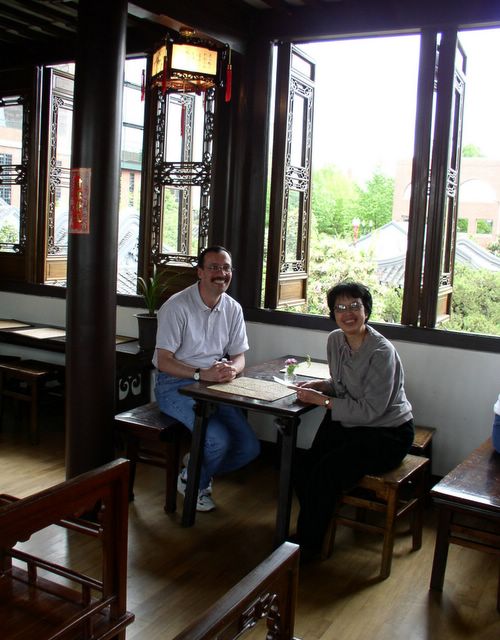
My friend Ly Sieng Ngo and I at the Portland Chinese Garden. Ly Sieng is our clinic's Cambodian interpreter, and a Pol Pot survivor. Read about her amazing life story on the Robert Wood Johnson program website.
Wednesday, May 18, 2005
Nuclear Medicine
From Steve Mueske's chapbook, Whatever the Story Requires, which I received in the mail the today. I opened it to this poem (see below), and was totally blown away. The image of the angel reminds me of Nicholas Cage's character in "City of Angels." I am looking forward to reading the rest of the book, including one poem titled: "After Reading of an Amazing New Device That Brings Back the Dead in Lifelike Holographic Images." Great title.
Nuclear Medicine
The angel has grown weary.
No one has made a run for eternity
since the days when the garden was young,
and the effort to stand ready
has made him mortal.
Bodies on white-sheeted gurneys
are lined up in the house of fear:
an old man, placid, nearly transparent;
a baby in a plastic tub, eyes taped shut,
tubes running along both arms;
others, spilling into the hallway
like oil at the scene of an accident.
In the lounge four hours later,
a boy watches TV, shivering
beneath a blanket. A nurse pops in
to ask how he is doing. He ignores her.
A man who's pissed a toilet full of blood
watches from the corner, wondering
whether the boy has just had a dose
or is merely cold from the air circulators
and the press of long hours.
He will come back soon,
and has begun to practice
naming shadows.
Nuclear Medicine
The angel has grown weary.
No one has made a run for eternity
since the days when the garden was young,
and the effort to stand ready
has made him mortal.
Bodies on white-sheeted gurneys
are lined up in the house of fear:
an old man, placid, nearly transparent;
a baby in a plastic tub, eyes taped shut,
tubes running along both arms;
others, spilling into the hallway
like oil at the scene of an accident.
In the lounge four hours later,
a boy watches TV, shivering
beneath a blanket. A nurse pops in
to ask how he is doing. He ignores her.
A man who's pissed a toilet full of blood
watches from the corner, wondering
whether the boy has just had a dose
or is merely cold from the air circulators
and the press of long hours.
He will come back soon,
and has begun to practice
naming shadows.
Tuesday, May 17, 2005
Franz Wright at SAM
Dean and I went to hear Franz Wright read at the Seattle Art Museum tonight, where he was presented the second annual Denise Levertov Award, by Image magazine and Seattle Pacific University. We had a yummy dinner at the Brooklyn first (Cosmo, Caesar, Carpaccio, Crab Cakes . . . I guess everything had to begin with a C?). There was a brief slideshow about Denise Levertov's life, and a so-so recording of her reading a poem. Franz Wright read fairly well; his poetry so dark and heavy and spare; his voice a thick mixture of anguish and defiance; with these brief moments of utter radiance that really catch you off guard.
"Medjugorje"
Highway shrine
lighthouse
of time
in the bleached-
gold winter
wheat —
listening in
another tongue, I
walk here
Come help me through
the long hour
of our death
from Walking to Martha's Vineyard
"Medjugorje"
Highway shrine
lighthouse
of time
in the bleached-
gold winter
wheat —
listening in
another tongue, I
walk here
Come help me through
the long hour
of our death
from Walking to Martha's Vineyard
Subscribe to:
Posts (Atom)

